

An inquiry arrives on a Tuesday morning: "Hi, we need a new website. Can we jump on a call this week?" There is no number in it. You book the call, prepare for it, and spend most of it learning about the business. Near the end you ask about money, and the budget turns out to be well below the smallest project you take on.
The fix is one question on the form, asked well. Put it after the questions about the project, offer four or five ranges whose lowest step is your real minimum, keep an "I'm not sure yet" option, and add one line that says why you are asking.
Should you ask for budget on a contact form at all?
In a 2023 thread on the maker community WIP, a content writer who asks for budget listed the gain plainly: it lets her "validate people and save time" on her calendar. She also named the cost. Some people "get intimidated", especially startups that have not set a budget yet, and some would rather talk about money on a call than type it into a form.
We think you should ask, and this is an opinion rather than a measured result. Our reasoning: someone who will not pick a rough range from a list is unlikely to be comfortable with a written quote a week later, while the people who do answer tell you in one click whether a call makes sense. The worries raised in that thread are about how the question feels, and that depends on where you place it and how you word it.
Where does the budget question belong in the form?
Ask it after the person has described what they need, never as the first or second question. By then they have spent a minute thinking about their project, and a question about its budget follows naturally from that. Asked first, before the person has said what they want, it is a question about money with nothing to attach it to.
A good order for a general inquiry form:
- Name, email and company.
- What they need help with (a choice of your services).
- A few questions about that service only.
- What success looks like for them, in their own words.
- Budget.
- When they want to start.
- Who makes the final decision.
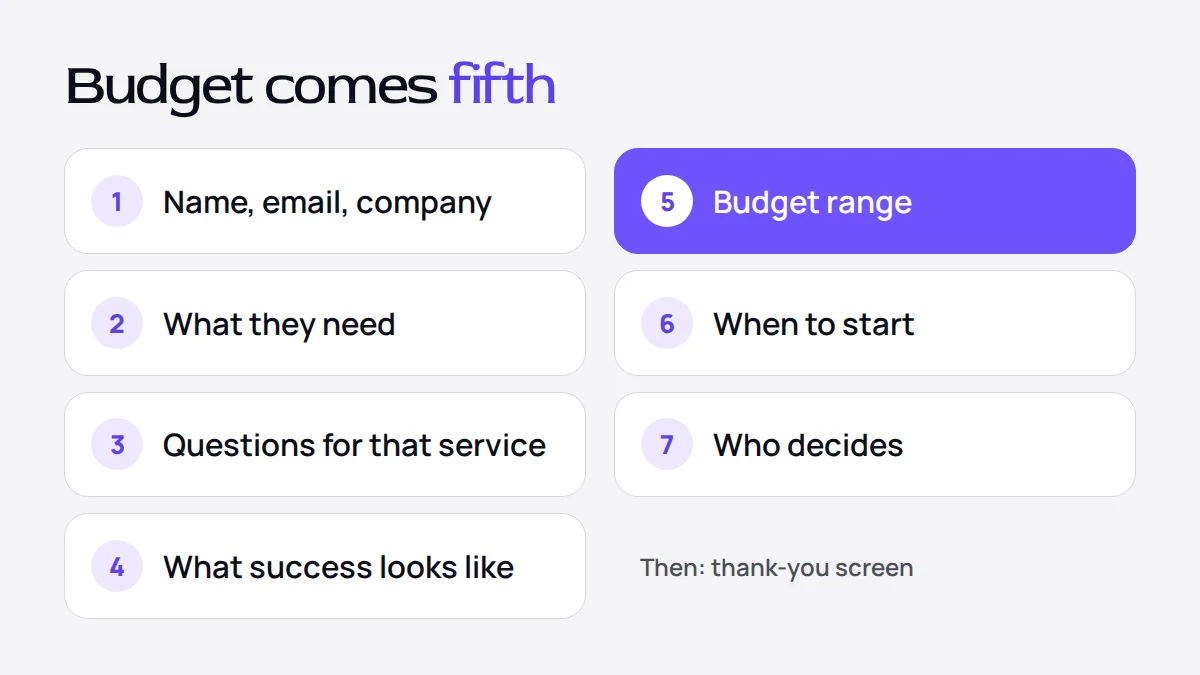
This is close to the order Kaptly's New client inquiry template uses. The questions in step 3 change with the answer to step 2, so a branding client and a website client each see only the questions about their own project before they reach the budget.
Ranges or an open answer box?
Use ranges. Picking the closest of five options asks less of someone than typing a figure they may not have worked out, and the answers can be sorted and compared across inquiries, which free text cannot.
The same WIP thread had one voice for a free-text box, on the grounds that every project is different. That is a fair argument if your projects have no typical size. Most studios and agencies do have typical sizes, even when no two projects are the same. Kurt Elster, quoted by the proposal tool Nusii, makes a similar point for live conversations: asking whether a budget is "closer to $5K, $50K, or $500K?" often works, because a few ballpark figures are easier to answer than an open question. We think a dropdown can do the same job on a form.
How do you set the ranges?
Start from the smallest project you would accept. That number is the top of your first range, and everything below it goes into one option. Then add three or four ranges above it, and leave the last one open at the top.
Here is an example for a studio whose smallest website project is €4,000. The figures are an illustration; use your own.
| Option on the form | What it tells you |
|---|---|
| Under €4,000 | Below your minimum. Reply kindly, perhaps with a smaller offer or a referral. |
| €4,000 to €8,000 | Your entry projects. |
| €8,000 to €15,000 | Your typical project. |
| €15,000 to €30,000 | Larger scope, worth a quick reply. |
| €30,000 or more | Read it today. |
| I'm not sure yet | Needs one more step before a call (see below). |
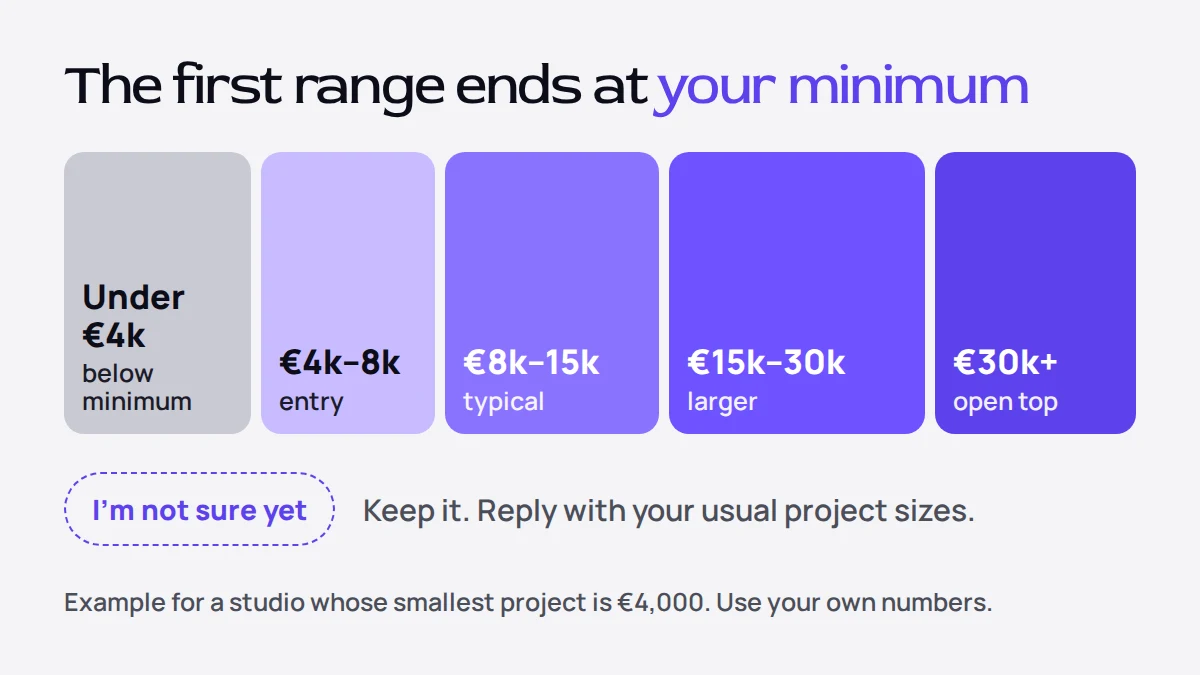
Price the ranges the way you sell: per project if you quote projects, per month if you sell retainers. Kaptly's template uses monthly ranges because it is written for ongoing marketing work. Let the ranges widen as they go up, as they do in the table, because the difference between a €4,000 and an €8,000 project matters more to your planning than the difference between €30,000 and €34,000. And show the currency your clients pay in.
Wording you can copy
Keep the question short and put the reason in a line under it. That line is where you answer the worry behind the question: "if I tell them my budget, will they just charge me all of it?"
Question: What budget do you have in mind for this project? Line under it: A rough range is fine. It helps us suggest the right scope before we talk.
Question: Which range is closest to what you plan to spend? Line under it: We use this to decide what to propose, not to set the price.
For retainers: What monthly budget are you working with? Line under it: Include everything you expect to spend with us each month.
We would avoid "What is your budget?" with an empty box under it. It asks for an exact figure and gives no reason for asking, so it carries both of the worries people raise about this question.
What should you do with "I'm not sure yet"?
Keep the option. If the question is required and this option is missing, a person who has no budget yet still has to pick a range, and that range tells you nothing. The honest answer tells you that this person has not yet decided what the project is worth to them.
So the useful reply is information first, and a call afterwards if it fits. Paul Jarvis and Marie Poulin, also quoted by Nusii, suggest publishing a minimum project fee or "starting at" prices so expectations are set early. The reply to an "I'm not sure yet" inquiry is a good place for exactly that: two or three sentences with your usual project sizes and an invitation to book a call if those fit.
What happens to the answer after someone submits?
Kaptly makes form software, so this part is about our own product. In Kaptly, each option of a choice question can carry points, and the points from several questions add up to a score. The New client inquiry template has four monthly budget ranges worth 0, 2, 4 and 6 points, gives "I'm not sure yet" 0, and adds points for an earlier start date, a larger team and for the person who makes the final call. A total of 9 or more marks the inquiry as Hot and sends you an email listing the budget, timing and decision-maker. A total of 4 or more marks it Warm.
The person who filled in the form sees none of this. They get a thank-you screen with their name and a promise to hear back within one to two business days.
You can start from the New client inquiry template after creating an account; it opens from the dashboard, and every range, point value and email in it can be changed to fit your own prices. If you would rather build the form yourself, the Guide explains how scoring and lead tiers work.